PB-002 · Personal Build
Catan Collector
After seeing dice roll after dice roll land on 5 one night (and not my 8s), I was curious to see if a single game was a large enough sample size to have normally distributed dice rolls. Once the idea of tracking dice was spawned, other things could be tracked like wins and turn times.
2026 · Arduino · Circuit design · Autodesk Inventor · 3D printing (FDM)
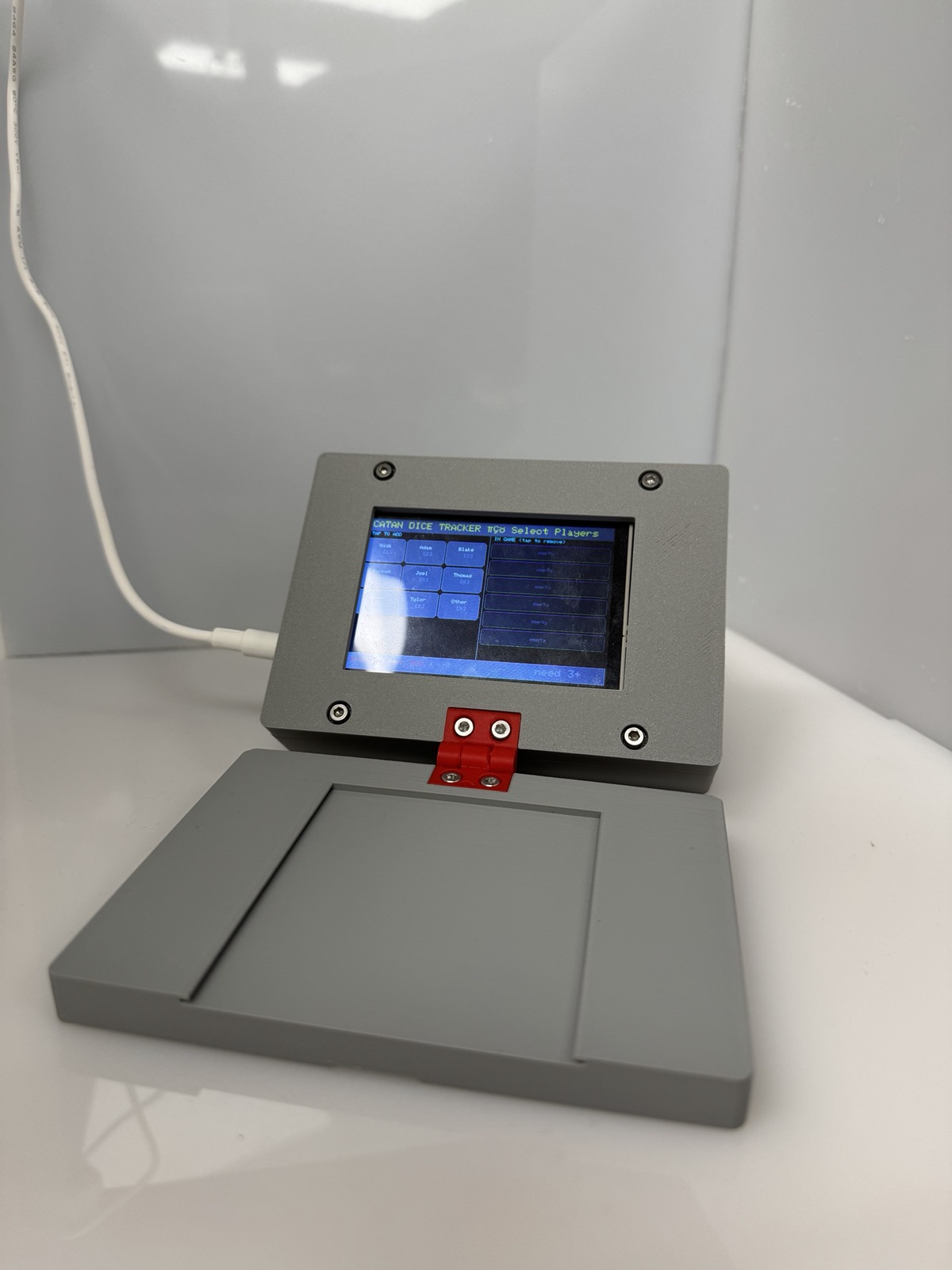
Overview
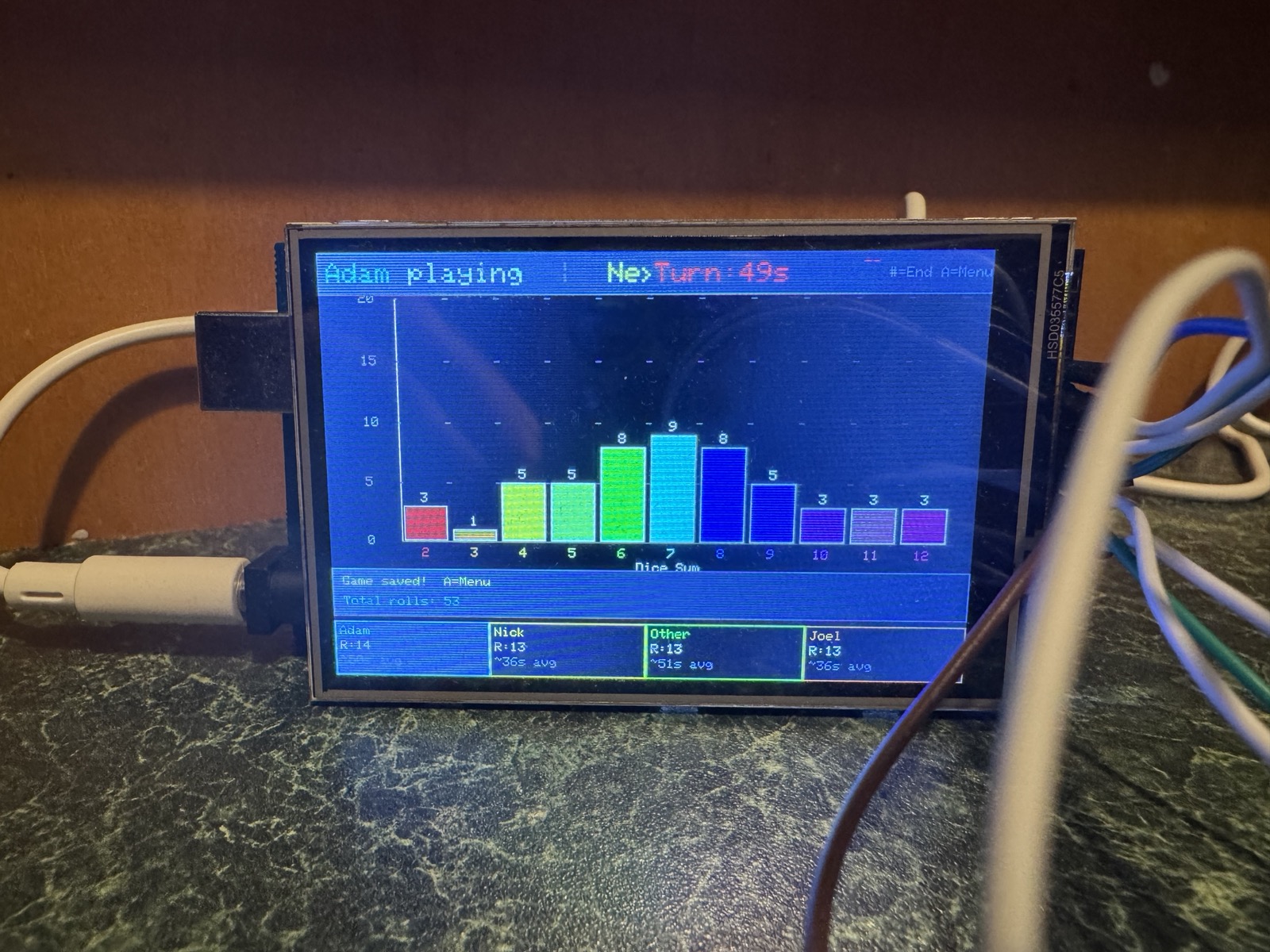
Turns out most games are normally distributed. Sometimes some rolls are represented more than others, but don't bank on 4s. That's not a real strategy. Like in finance, diversity of rolls plays a huge part. Another side effect is that when everyone has a timer going with their name beside it, things get fast. Like really fast. It does make the games that much more exciting.
Design
Initially the project was going to have a much smaller screen with a hat that plugged into the Arduino Mega and use an Arduino touchpad to input numbers. I liked the aesthetic, as it gave it a mini-laptop-like shape with controls on the bottom and a screen on top. For this project I tested a variety of print-in-place hinges. I found that printing the pin with one piece and having the other piece with a clearance hole had the best tolerance, leading to the smoothest movement and least wobble. FIG. 2 below shows the original prototype with the connected touchpad. Ultimately the touchpad and bottom half were never used, as my roommate lent me a whopping 5-inch touchscreen for this project.
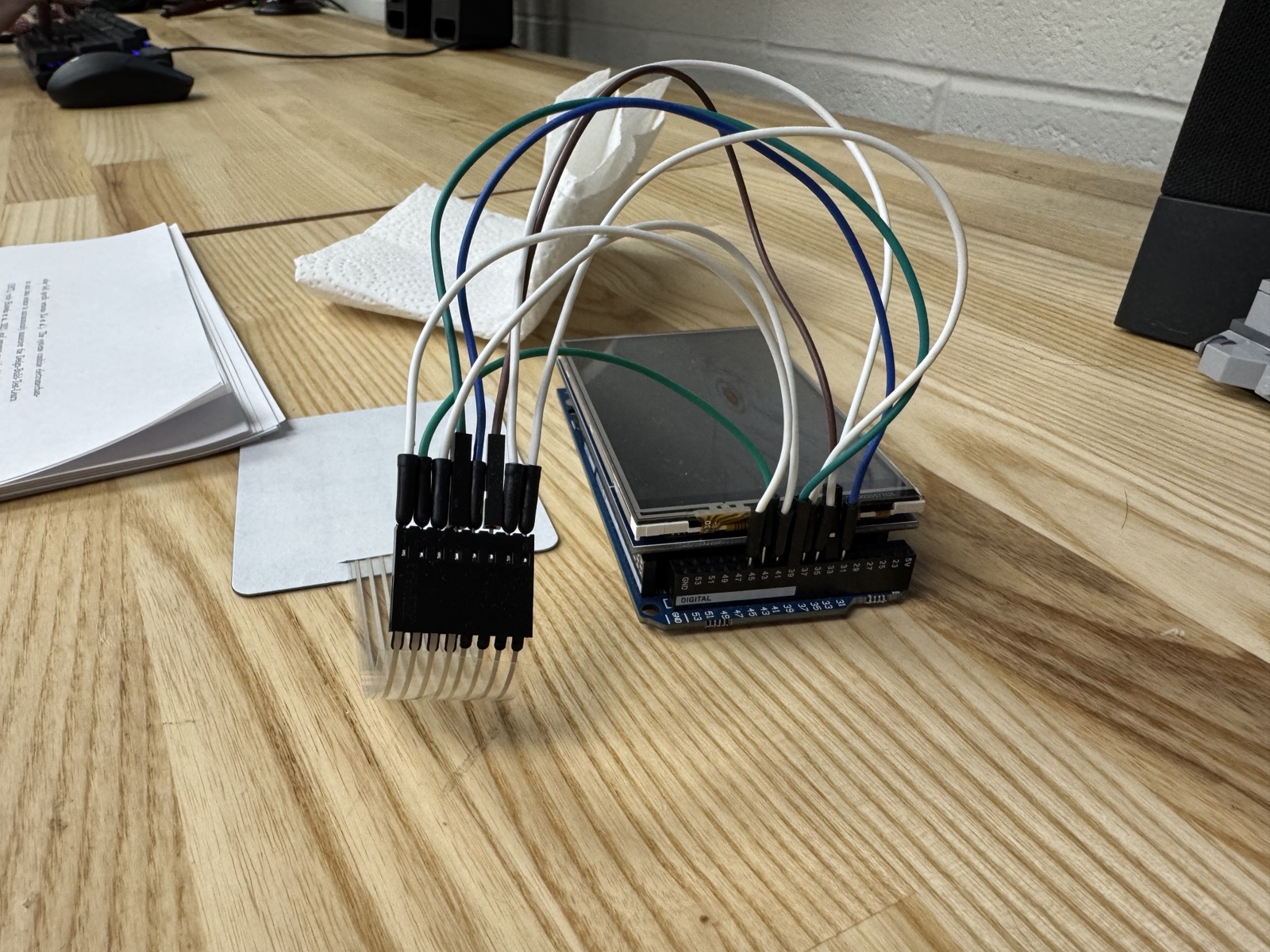
The Catan Collector has an initialization screen to select players in the order that the game will be played. Once more than 3 players are selected, a game can commence by hitting start. Then, once the first player rolls the dice and enters it by hitting the number on the graph, a counter will begin for that player's turn. The player's turn is considered done when the next person enters their dice roll.
Results
Unfortunately game stats could not be saved, as the touchscreen blocks the SD card slot. Aggregate stats could not be kept, but it was still fun to keep track of stats in a single game. The touchscreen also would not accurately map where the screen was pressed, so sometimes a few presses were needed. If I did this project again I would use a much smaller microcontroller, something like the RP2040. That would allow for a smaller footprint, quicker response times and easier programming.